
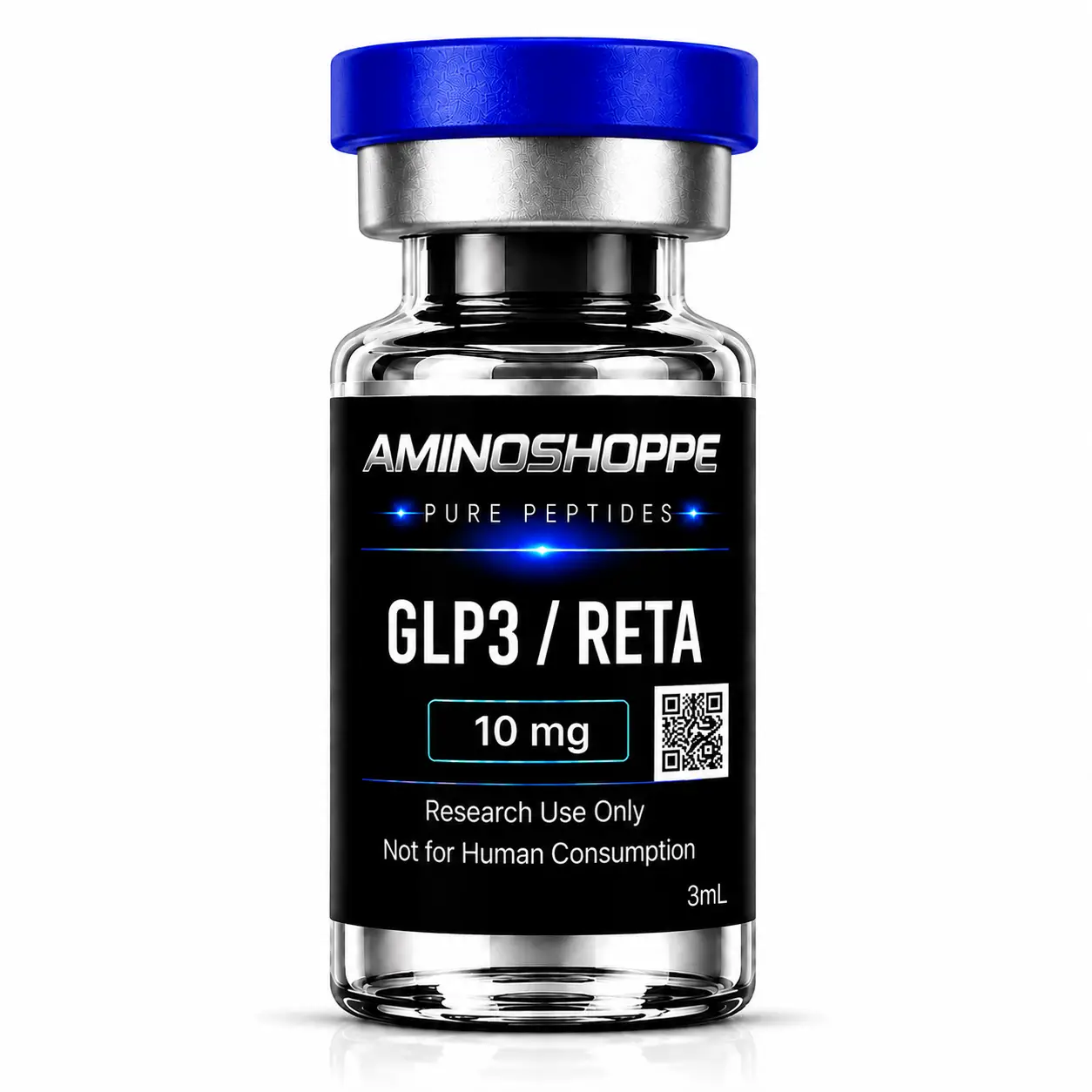


Premium Retatrutide
Price range: $45.00 through $495.00
Pure Retatrutide vials and vial kits. Includes 3rd-party lab verified COA. Fast FREE FedEx 2 day shipping on all orders over $50.
Description
 Retatrutide
-
Supplied as a lyophilized powder vial, manufactured to the highest chemical standards. Every batch is strictly synthesized as a reference standard for laboratory evaluation, in-vitro testing, and scientific development purposes.
-
Each size variation is accompanied by an independent third-party Certificate of Analysis (COA) verifying a purity level of 99% or higher, ID, net vial content, endotoxins, and vial conformity.
-
Laboratory Research Notice: This product is intended strictly for laboratory research and development use only.
 |
|
| Clinical data | |
|---|---|
| Other names | LY-3437943 |
| Identifiers | |
| CAS Number | |
| UNII | |
| ChEMBL | |
| Chemical and physical data | |
|
|
|
YA¹QGTFTSDYSIL²LDKK⁴AQA¹AFIEYLLEGGPSSGAPPPS³where letters with superscripted numbers refer to the following chemical modifications:
- A¹ – 2-aminoisobutyric acid (Aib).
- L² – leucine modified with an α-methyl substituent (MeL, 2-methylleucine).
- S³ – L-serinamide (L–serine with the carboxylic acid group replaced with a carboxamide).
- K⁴ – L–lysine with the amino group at position 6 modified with a side chain; specifically, (AEEA)-(γ-Glu)-(C20 diacid) (where AEEA is 2-[2-(2-aminoethoxy)ethoxy]acetic acid, commonly used as a spacer group in synthetic peptides).
Retatrutide is synthetically engineered and produced using solid-phase peptide synthesis (SPPS). This is when amino acids are added to a peptide chain and attached to solid resin forming a backbone. After the backbone is synthesized, the molecule is cleaved chemically, then purified. Lipidation modifications also occur, meaning a fatty-acid side chain is added to promote reversible binding to albumin. This modification allows for a longer drug half-life..
Additional information
| Strength | 1 vial-5mg, 1 vial-10mg, 5 vials-10mg, 1 vial-20mg, 1 vial-30mg, 5 vial-30mg, 10 vials-5mg, 10 vials-10mg |
|---|
Only logged in customers who have purchased this product may leave a review.
Related products
-

PT-141 10mg
$35.00 Read more -

SEMAX 10mg
$50.00 Read more -
KPV
$45.00 Add to cart -
Sale
Pure Tirzepatide
Price range: $55.00 through $375.00 Select options This product has multiple variants. The options may be chosen on the product page

Reviews
There are no reviews yet.